Showing posts with label nonfiction. Show all posts

Sunday, March 8, 2015

YALSA 2015 Hub Reading Challenge, Update #1


Even knowing that the YALSA Hub Reading Challenge was coming up, I still managed to get a late start with most of the list. Luckily, I've already read the Morris and Nonfiction selections, so I should be able to catch up. I'm only reviewing one book this week. This book is what set me so far behind! Even though there were many elements that I SHOULD have connected with, I simply couldn't get into it. I checked it out from the library in January and forced myself to finish it today. I'm not sure why it was such a difficult read for me, possibly because I have very little background knowledge about the information presented. Here's my review.  


Ida M. Tarbel: The Woman Who Challenged Big Business--and Won! by Emily Arnold McCully

Ida Tarbell was a successful investigative journalist at a time when most women did not work outside the home. Despite the fact that she herself was not a "typical" woman of the day, she did not support the right of women to vote. Her investigative work helped to shine a light on the dirty business tactics of John D. Rockefeller and Standard Oil.

While this book is well-researched and written, it just never really grabbed me. I think it's because I'm not all that interested in this particular period in history. That said, McCully's book would be an excellent resource for students looking for quality research about the social and political landscape of the early 1900's.

Sunday, January 11, 2015

2015 YALSA Morris/Nonfiction Reading Challenge, Update #1


The challenge before the challenge started a few weeks ago. I'm a little late to the party, but jumping in anyway. I can get through at least one of the lists before February 2, but I'm shooting for both. I love doing the YALSA Challenge every year because it helps me discover great books that I might otherwise miss. Thanks to a couple of snow days, it was a marvelous week to curl up and read.

Here is the Morris List:

The Carnival at Bray by Jessie Ann Foley
The Story of Owen: Dragon Slayer of Trondheim by E.K. Johnston
Gabi, a Girl in Pieces by Isabel Quintero
The Scar Boys by Len Vlahos
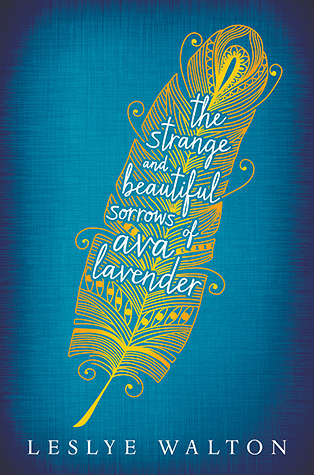
The Strange and Beautiful Sorrows of Ava Lavender by Leslye Walton


Here is the Nonfiction List:

Laughing at My Nightmare by Shane Burcaw
The Family Romanov: Murder, Rebellion & the Fall of Imperial Russia by Candace Fleming
Ida M. Tarbell: The Woman Who Challenged Big Business--and Won! by Emily Arnold McCully
The Port Chicago 50: Disaster, Mutiny, and the Fight for Civil Rights by Steve Sheinkin
Popular: Vintage Wisdom for a Modern Geek by Maya Van Wagenen


***************************************************

This week's completed books:

The Scar Boys by Len Vlahos 


Growing up is hard enough, even under ideal circumstances. After being horribly burned by a near-miss lightning strike, Harry Jones struggles to deal with the accident and to face himself. Thanks to a caring therapist and, eventually, some good friends, Harry learns to be an active participant in his own life.  There were many times as I read that I wanted to smack Harry upside his fat head. He isn't good at standing up for himself and he makes some dumb decisions. He also has a sly sense of humor that I loved and I rooted for him, even as he learned every lesson in the hardest possible way.

This is a well-done story about the power of music and friendship to help us transcend difficult times and to be better people. 

Gabi, a Girl in Pieces by Isabel Quintero

Gabi, a Mexican-American high school senior with a love for poetry and sopas, deals with all kinds of issues, as do her friends. Through her diary entries, which are fresh and funny, thoughtful and yearning, we join her as she and her peers deal with drug abuse, rape, teen pregnancy, self-esteem and body issues, homosexuality, faith and the lack of it, and sexism. Gabi struggles to come to terms with these issues in her life, and takes the reader along for the ride. The author is obviously trying to teach a few lessons here, but is never too heavy-handed. I love Gabi's sarcastic humor and her good heart. She is definitely a character who readers will care about and root for.

Some favorite quotes:

"Family. Familia. And while familia is the glue that keeps us crazy, it is also the glue that makes us who we are."

"Never ask the fat girl if she is hungry. She's always hungry. Even if she is not, she is, because food is safe and controllable and soothing and salty and sweet, and it doesn't scream at you or make you feel bad unless you are trying on clothes."

"Cinco de Mayo! Woo! Another holiday where people get to use sombreros and fake mustaches as proof of their understanding and commitment to learning about my heritage."

"...for a lot of people, high school is it--the best time of their life. Oh my God, if high school is supposed to be the best time of my life, I'm going to have the shittiest life ever." 

What kept this from being a five-star book for me was the awkward grammar and the way the Spanish was kind of unevenly integrated into the narrative. While I assume that the author used this style to make sure that Gabi's voice was authentic (and it did work) it brought me back to all the hours I have spent grading poorly edited student papers. I realize that other readers won't be as bothered by the grammar; I'm certainly glad that I read this book and will happily recommend it to teen readers.


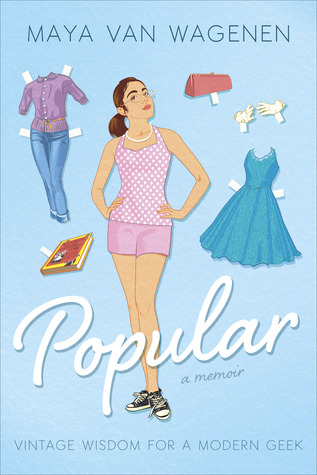
Popular: Vintage Wisdom for a Modern Geek by Maya Van Wagenen

Maya is an unpopular, nerdy middle schooler who is inspired by an old book, Betty Cornell's Teen-Age Popularity Guide, to spend her eighth grade year attempting to climb the social ladder.  Each month, Maya follows some of the tips in the book and writes about how her peers react. The results are all over the place--sometimes hilarious, sometimes thought-provoking, and sometimes utterly cringe-worthy. Regardless of the outcome, Maya handles herself with grace and kindness. She is wise beyond her years.  

This is a book that would have helped the shy, lonely teenager I used to be. I can't wait to share it with my students, and the other teens in my life. 

I'll leave you with Maya's final popularity tip: "Popularity is more than looks. It's not clothes, hair, or even possessions. When we let go go these labels, we see how flimsy and relative they actually are. Real popularity is kindness and acceptance. It is about who you are, and how you treat others.

The Port Chicago 50: Disaster, Mutiny, and the Fight for Civil Rights by Steve Sheinkin 

Though I knew a bit about how African American soldiers were treated during WWII before I read this book, I had never heard about the Port Chicago 50. Especially in light of recent events, this is a timely, engaging, and thought-provoking story. 


Without even basic safety training, African American soldiers were given the dangerous job of loading munitions from rail cars onto ships. When the inevitable accident finally occurred, hundreds of people were killed and injured. The navy officers blame the soldiers for the accident, but then expect them to get right back to the same work. The men refuse and are eventually told that if they continue to disobey orders, they will be charged with mutiny. Fifty men end up being charged and put on trial for mutiny. I won't give away the ending, but Thurgood Marshall gets involved. 

Though these men were instrumental in the Navy's decision to integrate, they have never received much recognition. This book left me better informed, but angry. The United States has certainly come a long way, but we're not there yet. 


The Family Romanov: Murder, Rebellion & the Fall of Imperial Russia by Candace Fleming

Russian history has never been all that interesting to me, and I must admit that I had very little background knowledge going into this book. I vaguely remembered reading about "Bloody Nicholas" in high school. Candace Fleming has done a stellar job researching and writing a book that brings  the Romanovs to vivid life. The intimate portrait of their private lives makes them seem much more human, and their ends that much more terrible. She also adds in snippets about the dreary lives of peasants from primary source documents. For them, it didn't matter much who was running the country--their lives were just hard. Finally, other figures who affected the complicated course of Russian history make an appearance--Lenin and Rasputin are highlights.

Even though I knew how the story was going to end, I was riveted nonetheless, a small part of me holding out the hope that Disney got it right about Anastasia after all.


Sunday, March 16, 2014

2014 YALSA Hub Reading Challenge Check-in #5


Now that I've read most of the graphic novels on the list, my weekly reading lists won't be as impressive from here on out.  I discovered a few gems this week, so my reading time was time well-spent.  Who am I kidding?  It usually is.

The Nazi Hunters: How a Team of Spies and Survivors Captured the World's Most Notorious Nazi by Neal Bascomb

Adolph Eichmann was the Nazi commander in charge of transporting millions of people to their deaths in concentration camps during WWII. After the war, he disappeared without a trace. A team of spies eventually tracked him down and brought him to Israel for a trial. Eichmann's trial gave survivors a chance to tell their stories and made the horrors of the Holocaust a reality for people around the world.

Though the story is an important one, I wonder if something got lost in the adaptation of this book from the adult book Hunting Eichmann. The storytelling itself is not exactly riveting, though the book is obviously well-researched and the story could be exciting. The writing style didn't do much for me.

Help for the Haunted by John Searles

When a middle of the night phone call summons her parents to a deserted church on a snowy night, Sylvie isn't all that surprised. After all, her parents' unusual vocation--helping troubled souls find peace--often takes them to strange places. On this night, Sylvie sleeps in the car until she is awakened by gunshots. Running into the church, she sees...

From here, the story alternates between past and present as Sylvie tries to solve the mystery behind her parents' murder. Lots of creepy moments (but not gory ones) make this a suspenseful read that would be appropriate for middle and upper grade readers. The paranormal aspect of the story was well done and kept me guessing.

Keep the lights on while you read and don't forget to lock the basement door!

Beautiful Music for Ugly Children by Kirstin Cronn-Mills

This book is the reason I participate in the YALSA Hub Reading Challenge. Every year, I pick up a bunch of books that I wouldn't normally read and find a few gems that I would have missed.

Gabe has always known he's a guy. Unfortunately, he is trapped in a girl's body and his family and friends know him as Liz. Gabe's family has a difficult time accepting him, even though they do love him. His best friend is accepting and supportive, but Gabe wants more than friendship, which causes some tension. I loved Gabe's relationship with John, a neighbor and mentor who provides the kind of unconditional support and love that every young adult needs.

Music is a huge part of this novel, from the A side/B side metaphor to the "_____ is the New Elvis" chapter titles to the many song and artist references. I think that most teen readers will relate to Gabe's passion for music and his efforts to be true to himself.

I cheered for Gabe and cried for him and I will enthusiastically recommend this book to my students. However, what kept me from giving this five stars was the one-dimensional bullies and the too-neat ending. That said, this is one of my favorites from the challenge so far.

A few favorite quotes:

"That's what bites about the future--there's no way to predict it. You just have to show up and see what happens."

"Rush Limbaugh can't be the new Elvis; he's too mean."

Strobe Edge, Volumes 1-6 by Io Sakisaka 

I really had to force myself to keep reading these. First of all, I am not a manga fan. Reading left to right is so ingrained in me that I kept reading the panels in the wrong order and having to go back and reread. The whole "I love him/her, but he/she doesn't like me back" got old pretty quickly. Twelve year old girls might like this series, but I did not.

Boxers by Gene Luen Yang

Boxers and Saints #1.

The Boxer Rebellion took place in China during the 1890s. Gene Luen Yang tells the story of this bloody war in two parts, the first from the perspective of Little Bao, a young Chinese boy who learns kung fu and how to use the power of the ancient Chinese gods. He eventually recruits an army (the Boxers) to defend his village and the rest of the countryside from foreign missionaries.

In his quest to free China from these "foreign devils," Little Bao becomes a person he can no longer recognize. This is a war story. It's a violent and not especially hopeful look at what happens when people go to war over culture and religion.

Saints by Gene Luen Yang

Boxers and Saints #2.

The Boxer Rebellion took place in China during the 1890s. Gene Luen Yang tells the story of this bloody war in two parts, the second from the perspective of Four Girl/Vibiana, a Chinese girl who converts to Christianity and sees visions of Joan of Arc. Her story intersects with that of Little Bao. 

As he does so well in his other work, the author combines realistic and magical elements that all come together in the end. This bloody and violent war story is not a happy one, but the vibrant artwork and compelling storyline will appeal to young adult readers.


Tuesday, March 4, 2014

2014 YALSA Hub Reading Challenge Check-in #4


Hooray for graphic novels! Quick and worthwhile reads helped pump up my total for the challenge. Since the weather is not giving me anything to be joyful about, at least I had some good books to help keep me warm.

Dogs of War by Sheila Keenan and Nathan Fox

I can never get enough books featuring animals to satisfy my students, and this is one that I will certainly add to my collection.

Three short stories inspired by real MWDs (military working dogs) show how dogs helped soldiers survive during wartime. The first story features Boots, a Mercy Dog during WWI.  His job was to locate wounded soldiers who might otherwise be left for dead.  The second story features Loki, a sled dog who protects his trainer's life during WWII.  The third story is the book's emotional center, featuring Lanford, a Vietnam veteran struggling to cope with PTSD.  A young neighbor and his naughty puppy enable Lanford to talk about his experiences in Vietnam and his close relationship with his scout dog, Sheba.


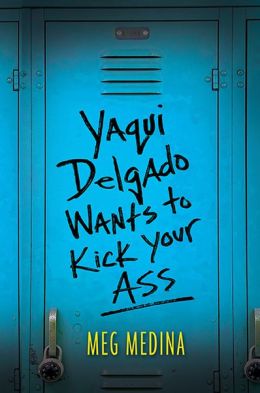
Yaqui Delgado Wants to Kick Your Ass by Meg Medina

When Piddy transfers to a new school, she's not too happy about it. But things quickly go from bad to worse when a school bully threatens to kick her ass for no apparent reason. At first, Piddy doesn't take the threat seriously, but as Yaqui and her friends continue to stalk her, Piddy gradually withdraws from everyone around her.

I enjoyed the Spanish sprinkled throughout the story and I think that teens, especially girls, will be able to relate to Piddy's struggle.

Will & Whit by Laura Lee Gulledge

Will (Wilhelmina) Huckstep is a smart and funny young woman who tries to avoid thinking about a family tragedy. She doesn't talk about her feelings with her aunt or her friends, but she is afraid of the dark and creates lamps out of found objects to try to chase away the shadows she fears. When Hurricane Whitney comes to town, Will has to find a way to keep the darkness at bay.


This is a beautifully done graphic novel with a focus on character development rather than plot. Will gradually learns to face her fears and to deal with her emotions so that she (and her friends) can move n with their lives. Despite a few places where the dialogue was a bit heavy-handed during Will's emotional breakthrough, the story was enjoyable and moving. I would especially recommend this for girls who are dealing with tough issues in their own lives.

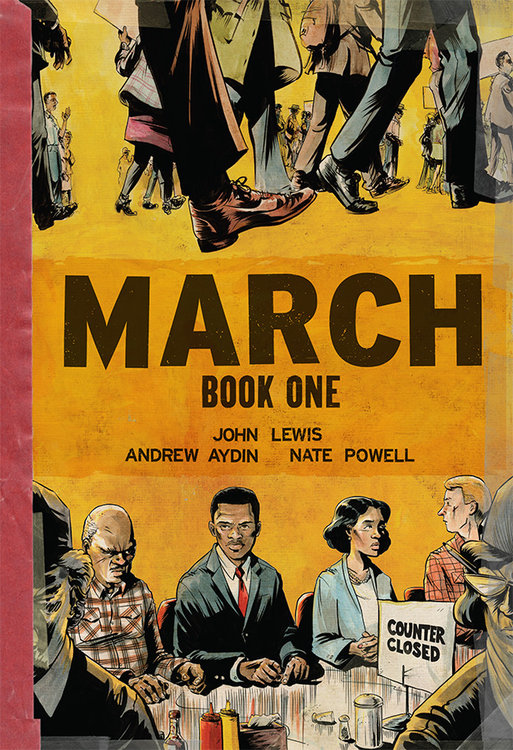
March (Book One) by John Lewis, Andrew Aydin, and Nate Powell

Book one of a planned trilogy about the life of Congressman John Lewis.

Congressman Lewis, an important part of the civil rights movement, started his life on a sharecropper's farm, preaching to his chickens and dreaming of becoming a preacher. He eventually met Dr. Martin Luther King and Jim Lawson and got involved in the non-violent protest movement. The student protesters were non-violent, but their opponents were not. I am in awe of the kind of bravery it took to stand up to violence and unfair treatment without lashing out and returning fire.

This well-done graphic novel chronicles an important period in American history and reminds us what can be accomplished when a group of people is united in a common cause.

The Adventures of Superhero Girl by Faith Erin Hicks

Our kick-ass heroine can leap tall buildings, but being a superhero is not exactly paying the bills.  She's angsty and insecure, and she feels overshadowed by her big brother who is, well, superhero-ier. I loved the artwork and the story.  I look forward to adding this title to my classroom library and sharing it with students far and wide ('cause that's MY superpower).


***************

I read this one for a book club and NOT for the YALSA Challenge.

The Language of Flowers by Vanessa Diffenbaugh

Victoria was abandoned as a baby and has spent her childhood in a dizzying array of foster homes and group homes. She is a prickly, unlikable character, but as we see in the glimpses of her childhood, she has some pretty good reasons for refusing to trust the people who profess to care about her. In chapters that alternate between past and present, we gradually learn Victoria's story and how she sabotaged her last chance to be adopted. Her regrets about Elizabeth, who could have been her mother, haunt her.

Her one passion is flowers and their meanings (which she learned from Elizabeth). After turning 18 and being emancipated by the state, she becomes homeless until a chance encounter with a gruff Russian florist leads to a job and a place to live. She meets a guy at the flower market who understands the language of flowers. One of my favorite scenes in the book is their back and forth dialogue, spoken entirely with flowers.

The author lost me in the middle of the novel. Just when Victoria seems to be opening to the possibility of love, she walks away. The plot in this section felt forced and unbelievable. And Victoria made some decisions that were very difficult to either like or understand.

Victoria started to grow up a bit during the final third of the story and I was drawn back in. While the ending wasn't exactly happy, I found it at least hopeful.

Especially in the first third of the novel, I found the language beautiful and poetic. I'm not sure if the writing actually got less polished toward the end or if I noticed more awkward language as I went on because I wasn't as caught up in the story. This book made for a great book club discussion, as opinions ranged all over the map!

Since reading this book, when I'm in a bad mood I want to surround myself with thistles. 

Monday, June 17, 2013

2013 YALSA Hub Reading Challenge - Update #18


Alas and alack! Summer vacation has been so darn busy so far that I am simply exhausted after only a week away from school. My husband and I have started a new diet and exercise program, visited several doctor's offices, and wandered around our local farmers' market purchasing locally grown foodstuffs for delicious home-cooked meals. What we have not done much of is, you guessed it, reading. I did finish one more book from the list, as well as another that's been on my nightstand for several months.


Pure by Julianna Baggott

Pure is the first in a trilogy. 


The world-building is phenomenal; plotwise, nothing much happens until very near the end of the book (and it is an enormous book).


In a horrifying post-apocalyptic world, enhanced nuclear weapons have destroyed nearly everything. The survivors have been fused with whatever they happened to be holding (or standing next to) during the Detonation, creating a variety of grotesque mutations. Pressia, 16, has a doll's head in place of one hand. Another character has birds fused into his back. Other characters, called Groupies, are connected to other people. The descriptions of these survivors are disturbing, and I think, what made this book very difficult for me to read.


There is another group of survivors, people who were kept safe from the Detonations, protected inside of the Dome. They are called Pures. Partridge lives in the Dome, which is controlled by his father. Despite his privileged upbringing, Partridge has never felt like he fits in. When he discovers that his mother might have survived, he escapes from the Dome and sets out to find her.


Pressia and Partridge, on the run for their own reasons, soon find out that more than 
mere chance binds them together.

***********************************************************************
Not on the YALSA list, but worth a read.

Freakonomics:  A Rogue Economist Explores the Hidden Side of Everything by Steven D. Levitt and Stephen J. Dubner

Leavitt (an economist) and Dubner (a journalist) collaborate to answer some rather strange questions that, on the surface, seem to have little to do with economics.

Which kills more children--guns or swimming pools? How much money do drug dealers really make? Which factors determine whether or not a child will have a successful life? Can statistics reveal cheaters on standardized tests? How does access to safe and legal abortions affect the rate of violent crime in our cities?

A fascinating read.

Sunday, April 28, 2013

2013 YALSA Hub Reading Challenge - Update #11


Only three books this week, but two were long ones.


One Shot at Forever: A Small Town, an Unlikely Coach, and a Magical Baseball Season by Chris Ballard

Set in the late 60's and early 70's, this is the true story of a small midwestern town and it's little team that could. Like all great baseball stories, this one is about more than baseball. When a young, liberal teacher comes to Macon to teach English, he shakes up the conservative town and only ends up coaching the baseball team because no one else wants the thankless job. 

Lynn Sweet, never intending to hang around Macon for long, ends up making a profound difference in the lives of his students and players. Sweet is the kind of teacher we all wish we had, whose lessons extend far beyond the classroom walls. His students demonstrate that some of the lessons we need to learn, and those that stick with us the longest, can't be measured by a standardized test.

Like Mike Lupica, another of my favorite sporty writers, Chris Ballard tells an engaging story that is accessible even to those of us who don't care much about sports.


The Isle of Blood by Rick Yancey

The Monstrumologist, book three.

When Dr. Warthrop sets off on a quest with a new apprentice to find a monster that no one has ever seen (or at least lived to tell about), Will Henry is left behind. For the first time since the death of his parents, he has a chance at a normal life. But Will Henry no longer fits in with a normal family, and despite himself, he misses Warthrop and feels that his place is wherever the doctor is. When Warthrop's assistant returns to tell Will Henry of the doctor's death, Will Henry is convinced that the man is lying. 

Will Henry is soon on Warthrop's trail, and then on his way to Socotra, the Isle of Blood. On the hunt for a mythical monster that kills so violently that the sky literally rains blood and then builds nests from the scattered human remains, Will Henry will need to confront the darkness in his own soul.

Well-written, creepy gothic horror, suitable for adults and mature YA readers.


The Diviners by Libba Bray

The Diviners (the first in a new series, hooray!) is my favorite type of book--a blend of genres, fun to read and difficult to classify. It's a mix of fantasy, historical fiction, mystery, and suspense, with a dash of romance thrown in for good measure. Bray has painstakingly researched the Roaring Twenties and her gorgeous prose brings the period, and her characters, vividly to life.

After getting in trouble back in Ohio, Evie O'Neill's parents send her to New York to stay with her uncle. An expert in occult matters, he runs The Museum of American Folklore, Superstition, and the Occult--known by the locals as The Museum of the Creepy Crawlies. When Uncle Will is asked to help the police investigate a series of brutal, occult murders, Evie comes along for the ride. Will her ability to "read" objects help her solve the crimes or make her a victim?

Evie is not the only character with a special gift. There's also a pickpocket on a mission to find his mother, a Ziegfeld girl hiding from a dangerous past, a numbers runner with healing powers, and a museum employee who is more (and less) than he seems. Despite the supernatural elements, these characters are well-developed and realistic.


The audio version is delightful, and some of the expressions that felt a bit forced when I read them were much more natural while listening. 

Sunday, March 31, 2013

2013 YALSA Hub Reading Challenge - Update #7


It's been a girl power week of reading. Hooray! If only Spring Break could happen more often...


The Miseducation of Cameron Post by Emily M. Danforth

Wow. I loved this book. 

First, it's a beautifully told coming-of-age story set in a small town in Montana. The writing is luxurious and brings the setting fully to life. The characters are well-rounded; even the less sympathetic ones aren't all bad. The length might scare some readers away, especially since this is not a Twilight-ish book that a reader can speed through. This is a book to savor, like the unbearably long, hot days of summer that seem to stretch ahead forever, but end all too quickly. 

The fact that Cameron Post is a lesbian is important to the story, but it's not the only aspect of her life that's important to the story. She's a realistically drawn character (faults and all), and her gayness is simply one part of who she is. "I just liked girls because I couldn't help not to." Any young adult, as well as many adults, will be able to relate to Cameron's struggle to find her place in the world around her.

Cameron's parents die in a car accident when she is 12, and her evangelical Aunt Ruth moves in to care for her and her ailing grandmother. For awhile, Cameron pretty much continues to live her life as she wishes, except for church on Sundays and the mandatory youth group. "Being a true believer meant helping others, lots of others, to believe just like me. Rather than convincing me of the righteousness of this kind of believing, rather than making me certain of its correctness, it made me question, and doubt, all the more."

When Ruth finds out about Cam's love affair with a girl in town, she sends Cam to a "pray the gay away" school affiliated with her church. Even as she pretends to play along, Cameron remains skeptical that the staff of God's Promise will be able to cure her of something that is not a disease. Cameron comes to see that the staff really have no idea what they are doing, though she believes that they mean well. She describes Lydia, the head counselor, this way: "...witnessing her administration of ten zillion rules and codes of conduct, all of which she applied to her own life, made her seem fragile and weak, in need of the constant protection of all those rules..." I guess this line resonated with me because it often seems to me that ultra-religious people are obsessed with sin. Like the ONLY thing that keeps one from committing mayhem is the prohibition against doing so. One could argue that truly moral people do not require the threat of punishment to do the right thing. They do the right thing even when no one is watching, judging, or threatening punishment.

While Cameron is not always likable, you'll root for her as she struggles to be true to herself and to live her life according to her own conscience. As she says in a sort of communion with her parents, "Maybe I still haven't become me. I don't know how you tell for sure when you finally have." 

Frank depictions of sex and drug use. Highly recommended for mature readers.


Monstrous Beauty by Elizabeth Fama

Marvelous story. Marvelous, lush writing. Did I mention that this story is marvelous?

Syrenka is a mermaid, but more of the Brothers Grimm variety than the Disneyfied version we've come to know. She is immortal and deadly, but willing to risk everything when she falls in love with Ezra. They are happy for a time, but the consequences of Syrenka's choices prove deadly.

Many generations later, Hester meets a handsome young man on the beach; the two feel an instant connection, like they've known each other forever. Because the women in her family have some unexplained affliction that causes them to die right after giving birth, Hester is determined to remain alone forever. But, still, there is something about Ezra...

Syrenka's and Hester's intertwined stories are told with prose that flows like ocean currents in alternating chapters. The world of mermaids comes alive in this entrancing tale that combines fantasy and folklore, romance, historical fiction, realistic fiction, and mystery.


Prom and Prejudice by Elizabeth Eulberg

"It is a truth universally acknowledged, that a single girl of high standing at Longbourn Academy must be in want of a prom date."

Fans (especially younger ones) of Jane Austen's Pride and Prejudice will enjoy this frothy and fun retelling of the classic novel of manners. It's a quick and easy read.

Lizzie Bennet, one of only two scholarship students at the prestigious Longbourn Academy, is a promising musician who dreams of playing in Carnegie Hall. Aside from Charlotte, the other scholarship student, and her roommate, Jane, no one at Longbourn wants anything to do with Lizzie, unless it's to torment her with mean-girl pranks.

Jane falls in love with Charles Bingley, a student at the equally exclusive boys' school, Pemberley, and Lizzie is partnered up with Charles' friend, the wealthy and pretentious Will Darcy. Misunderstandings and crossed signals abound, but readers familiar with the story will realize that everything is going to turn out all right in the end.


Alanna: The First Adventure by Tamora Pierce

Tortall Universe, Song of the Lioness #1.

Alanna and her twin brother, Thom, are about to go their separate ways--Alanna to a convent to learn magic, and Thom to the castle to learn to be a knight. Of course, Thom would rather learn magic and Alanna would rather be a knight. Surprise, surprise...they switch places.

We don't hear much from Thom, but Alanna (aka Alan) discovers that the life of a page is harder than she had expected. At times, Alanna seems a little to good to be believable, but she's a strong female character. She finds a well of strength inside herself that will help her be the hero she has always dreamed of. 

A fight between good and evil perfect for middle level readers.


First Test by Tamora Pierce

Tortall Universe, Protector of the Small, #1.

Since I read Alanna: The First Adventure in the same weekend, First Test felt very similar.  Like Alanna, Keladry of Mindalen longs to be a knight. She comes to the castle to become a page, but she does so openly, without concealing her gender. Of course, this opens her up to almost constant abuse from the other pages. Despite the challenges, Keladry refuses to give up and proves herself the equal, and in many cases the better knight, than the other pages.

Keladry, even more than Alanna, is a character to admire. She doesn't strive to become a knight simply to escape her fate as a proper court lady; she believes wholeheartedly in chivalry and protecting those who need protection. She stands up for others and calls the other boys to the carpet when they don't want to follow her lead.

Another excellent fantasy for middle level readers.


**************************************************
These weren't on the YALSA list, but worth a look.


Beauty Queens by Libba Bray

This review refers to the audiobook, read by the author. The footnotes that may have annoyed me had I read this instead of listened to it, came to wonderful, hilarious life.

Of the 50 young women and their chaperones who crash land on a deserted tropical island, only 12 teens survive. Imagine Lord of the Flies, but with more mascara and push-up bras.

I wasn't too sure about this concept at first, as I generally prefer Libba Bray when she's doing historical fiction. However, once I got drawn in, I loved the satire about our consumer culture and unrealistic expectations for women. Bray's beauty queens begin by seeing each other as obstacles; once they get to know each other, they realize they can only succeed together.

The thing I love most about satire is that it makes you laugh, even as it makes you think. However, misogynists beware: feminism abounds. If you like your women quiet, obedient, and pregnant, you'll probably hate this book. I thought it was hilarious and empowering.


Viral Storm: The Dawn of a New Pandemic Age by Nathan Wolfe

There were several things I liked about this book, even though it's not the type of thing I usually read. First, as a science novice, I appreciated the simple explanations of how viruses evolve and function. Learning how viruses jump from animals to humans was fascinating. Wolfe's assertion that perhaps we are overspending on stopping terrorist attacks and would be better served (in terms of protecting human life) by funding more scientific research makes perfect sense. Although his name-dropping goes a bit overboard at times, I get that he's doing it to highlight the useful research that is happening around the world and to remind us to keep funding it.

It's funny that some people view this book as "alarmist." I didn't feel that way at all. On the contrary, I felt that Wolfe was giving both sides about viruses. They aren't all trying to kill us. Many viruses are beneficial, or at least do no harm, and can be harnessed to help fight disease. His assertion is that we should not be trying to eradicate all viruses. Instead, we should be focused on the truly harmful ones that have the ability to cause pandemics.